

Last Updated: October 26, 2026
Quick Summary
Whether car organizers fit your vehicle depends on your vehicle's dimensions, the organizer's size, and how you plan to install it. Most organizers work across multiple vehicle types, but fit varies significantly. Measure your trunk, check backseat compatibility, and verify seat gap sizes before purchasing.
- Measure trunk width, depth, and height, then compare these dimensions to the organizer's specifications before buying.
- Backseat organizers require compatible headrests and sufficient space between front and rear seats to avoid interfering with legroom.
- Seat gap organizers vary by vehicle type: sedans have narrower gaps, SUVs have moderate gaps, and trucks often have wider gaps.
- Read customer reviews from owners of your specific vehicle model and year to verify real-world fit compatibility.
- Check the organizer's attachment method and material compatibility with your vehicle's interior before committing to purchase.
Table of Contents
- Understanding car organizers and vehicle fit
- How to measure a car trunk for an organizer
- Backseat car organizer fit: what to check
- Seat gap organizer compatibility across vehicle types
- Adjustable car organizers for flexible storage
- Verifying fit before you buy
- Choosing the right organizer for your vehicle
- Frequently Asked Questions
Understanding car organizers and vehicle fit
The car organizer market is growing fast (Car Organizer Market Size, Trends & Forecast 2035 - Wiseguy). But here's what matters: not every organizer fits every vehicle. At Ride and Roam Co, we help travelers and commuters find storage solutions that actually work in their cars. The real question isn't whether car organizers exist, it's whether the car organizers fit your specific vehicle without creating new problems.
Will car organizers fit my vehicle? The answer depends on three things: your vehicle's dimensions, the organizer's size, and how you plan to install it. Most organizers work across multiple vehicle types, but fit varies significantly. A trunk organizer designed for a sedan may not work in an SUV. A backseat organizer for a family vehicle might not secure properly in a sports car.
This guide walks you through the exact steps to verify fit before you buy. We'll cover measuring your trunk, checking backseat compatibility, and understanding how different vehicle types affect organizer placement. By the end, you'll know exactly what will work in your car.
How to measure a car trunk for an organizer
Measuring your trunk is the first step to finding a trunk organizer that actually fits. Start by measuring three dimensions: width, depth, and height.
Measure the usable space, not the decorative trim. Push the tape into corners and along the floor to get exact numbers. Width is measured side to side at the widest point.
According to Car and Driver's trunk organizer testing, comparing organizer measurements with your vehicle's available cargo space is essential before deciding on a size. Write down all three numbers. Round up slightly to account for items you'll store inside the organizer itself.
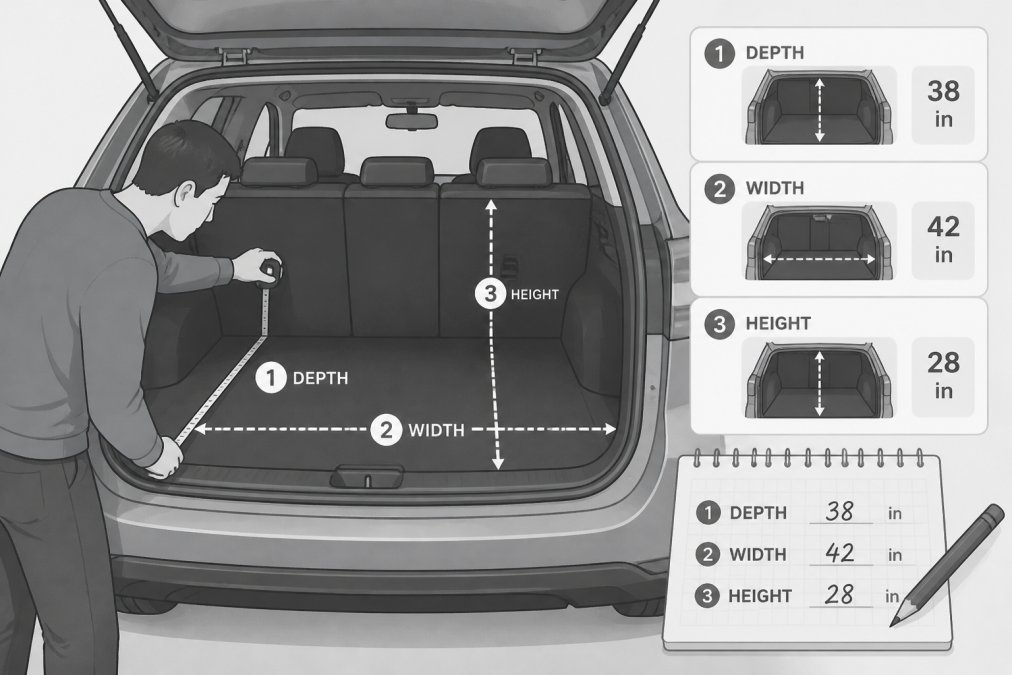
Next, check the organizer's specifications against your measurements. Most product listings show dimensions in inches or centimeters. Convert your measurements to match.
Consider vertical space carefully. Some trunk organizers sit high enough to block rear visibility or interfere with the trunk lid. A collapsible organizer like the Collapsible Car Trunk Storage PU Leather offers flexibility here since it compresses when not in use.

Also check for obstructions. Spare tires, wheel wells, and emergency equipment take up space. Map out where these sit in your trunk, then plan where the organizer will go around them.
Backseat car organizer fit: what to check
Backseat organizers hang from the front seat's headrest or attach to the seat back itself. Fit depends on your seat design and headrest style. Not all headrests accept organizer straps. Some seats have integrated design features that prevent attachment altogether.
Start by examining your front seats. Can the headrest move up and down? Does it have a removable post or a fixed design? Organizers with adjustable straps work best on movable headrests. Fixed headrests limit your options.
Check the seat back's material and texture. Cloth seats grip better than leather. Smooth leather can cause organizers to slide. Anti-slip features on the organizer help, but material compatibility still matters. A Car Backseat Organizer with cloth construction works reliably across most seat types.

Measure the distance between the front seat and rear seat. Backseat organizers hang down into this space. If your vehicle has a tight cabin layout, the organizer might interfere with front passenger legroom.
Consider your vehicle's seat configuration. Luxury vehicles with adjustable front seats sometimes have electronics or mechanisms that conflict with hanging organizers. Minivans and SUVs with spacious cabins rarely have this issue.
For families with young children, durability matters. Explore a detailed buying guide focused specifically on backseat organizers for more detailed recommendations. Backseat organizers designed for your vehicle type fit more securely and handle the wear from daily use better than generic options.
Seat gap organizer compatibility across vehicle types
Seat gap organizers fill the space between the seat cushion and the center console. This space varies dramatically across vehicle types. Compact cars have narrow gaps. Full-size trucks have wide gaps. Some vehicles have no gap at all.
Measure your seat gap before buying. Sit in the driver's seat and measure the space where the seat meets the console. Use a ruler or measuring tape pushed straight down into the gap. Measure at multiple points; the gap might be wider near the seat back and narrower near the seat cushion.
Most seat gap organizers are universal, but fit quality depends on this measurement. A gap filler designed for a narrow space won't work in a wider gap. It will shift and fall out. A Car Seat Gap Filler Organizer comes in 2-piece sets, so you can test fit before fully committing.
Vehicle type significantly affects compatibility:
- Sedans: Typically have narrower gaps. Most universal organizers fit well.
- SUVs and crossovers: Gaps range from moderate to wider. Larger organizers work better here.
- Trucks: Often have the widest gaps. You may need multiple organizers or a truck-specific design.
- Minivans: Gaps vary by model but typically fall in a moderate range.
- Sports cars: Gaps are often very narrow or non-existent due to integrated console design.
Material compatibility also matters. Seat gap organizers with PU leather or rubber bases grip better than plastic. They stay in place even on smooth leather seats.
Collapsible Car Trunk Storage PU Leather (1 piece) →
Adjustable car organizers for flexible storage
Adjustable car organizers adapt to different vehicle layouts and storage needs. They offer the best fit flexibility when your vehicle's dimensions don't match standard organizer sizes.
Look for organizers with retractable straps or expandable compartments. These adjust to your specific trunk size or backseat configuration. A trunk organizer with adjustable dividers lets you customize storage for groceries one trip and tools the next.
The Trunk Organizer for Car features 2 retractable straps and adjustable compartments. This design works across different trunk sizes without requiring a perfect fit from the start. The non-slip bottom strips keep it stable on bumpy roads, and the rectangular shape maximizes space efficiency.

Adjustable height is another key feature. Some backseat organizers have straps that shorten or lengthen. This lets you position the organizer higher on tall headrests or lower on shorter ones. Measure your headrest length and confirm the organizer's strap range covers it.
Collapsible designs offer the ultimate flexibility. When you don't need storage, they fold flat and take up minimal space. When you do need them, they expand to full capacity.
Consider your vehicle's specific features. Vehicles with adjustable cargo floors, removable seats, or fold-flat designs offer more organizer placement options. Vehicles with fixed interiors limit where organizers can go. Adjustable organizers work best in flexible vehicle layouts.
Verifying fit before you buy
Before committing to an organizer purchase, verify fit using these steps. First, compare the organizer's exact dimensions to your vehicle measurements. Check the product listing for width, depth, height, and weight capacity. Verify the organizer's material is compatible with your vehicle's interior.
Second, check the attachment method. Does it require straps, adhesive, or mounting hardware? Does your vehicle support that method? Backseat organizers need compatible headrests. Trunk organizers need enough space for non-slip materials to grip the floor. Seat gap organizers need the right gap width.
Third, read customer reviews from owners of your vehicle type. Search for your specific model year and vehicle type in the reviews. Look for comments about fit, durability, and installation difficulty. Customers often mention if an organizer doesn't fit certain vehicle variants.
Fourth, check the return policy. If the organizer doesn't fit when it arrives, you can send it back. This gives you a safety net. At Ride and Roam Co, we stand behind our products because we know they're designed for real vehicles and real needs.
Finally, measure twice and order once. Mistakes at the measurement stage are cheaper than shipping returns. Take photos of your trunk, backseat, and seat gaps. Reference these photos when reviewing product dimensions online.
| Verification Step |
|---|
| What to Check |
| Why It Matters |
| --- |
| Dimensions |
| Organizer width, depth, height vs. your vehicle measurements |
| Prevents ordering something too large or too small |
| Attachment method |
| Straps, adhesive, or mounting hardware compatibility |
| Ensures the organizer stays secure during driving |
| Material type |
| Cloth, leather, PU leather, rubber compatibility |
| Affects grip and long-term durability |
| Vehicle reviews |
| Customer feedback from your specific model and year |
| Real-world fit data from similar vehicles |
| Return policy |
| Days allowed, shipping costs, restocking fees |
| Protection if the organizer doesn't fit as expected |
Choosing the right organizer for your vehicle
The right car organizer depends on your vehicle type, your storage needs, and how much space you're willing to dedicate to organization. Start by identifying your primary storage challenge. Do you need trunk organization for road trips?
Match the organizer type to the challenge. Trunk organizers handle bulk storage. Backseat organizers keep rear passengers' items contained. Seat gap organizers solve the problem of items falling between seats.
Vehicle type shapes your options. Sedans work well with standard trunk and backseat organizers. SUVs and trucks benefit from larger capacity organizers. Minivans need backseat solutions that don't interfere with child safety seats.
Consider durability and material. PU leather organizers resist moisture and wear better than cloth. Non-slip materials keep organizers stable on smooth surfaces. Reinforced stitching handles repeated use without tearing.
Budget matters, but so does longevity. A $60 organizer that lasts two years costs more per year than a $150 organizer that lasts five years. Calculate cost per year of expected use.
Test compatibility before committing. Measure your vehicle. Compare specifications. Read reviews from owners of your vehicle type. Verify the return policy. These steps take 20 minutes but save you from costly returns and frustration.
Finding the right car organizer starts with honest assessment of your vehicle's dimensions and your storage needs. Measure your trunk, check your backseat configuration, and verify seat gap sizes.
Frequently Asked Questions
What should I measure before buying a car organizer?
Measure your trunk or cargo space length, width, and height in centimeters. Note any wheel wells, protruding features, or spare tire locations that reduce usable space. For backseat organizers, measure the seat back height and width. For seat gap organizers, measure the gap width between your seat and centre console. Compare these dimensions to the organizer's specifications before purchasing to ensure car organizers fit your vehicle properly.
How do I know if a car organizer will fit my vehicle?
Check the organizer's dimensions against your vehicle's cargo or seating space. Compare length, width, and height measurements in centimeters. Verify attachment points: trunk organizers need a stable, level surface; backseat organizers require accessible headrests; seat gap organizers need accessible seat seams. Review the product listing for vehicle compatibility notes. Many organizers, like the Trunk Organizer for Car with non-slip bottom strips, are designed for adjustable use across different vehicle sizes, but always confirm fit before purchase.
Are car organizers adjustable to fit different vehicles?
Many modern car organizers include adjustable features. The Trunk Organizer for Car offers a rectangular, adjustable structure that fits various trunk sizes and configurations. Backseat organizers with foldable designs adapt to different seat heights. Seat gap organizers use universal fit designs that work with most vehicle seat seams. However, adjustability has limits: extremely compact cars or large trucks may require vehicle-specific models. Always verify the adjustment range matches your vehicle's dimensions before buying.
Will a trunk organizer fit in a compact car?
Compact cars typically have limited trunk space, so measure before purchasing. A 95L trunk organizer may not fit; smaller S or M sizes are better choices for compact vehicles. Compare your trunk dimensions (length, width, height in centimeters) to the organizer's specifications. The Collapsible Car Trunk Storage in smaller sizes works well for compact cars and collapses flat when not in use, maximizing flexibility. Always verify fit and check for wheel well interference before committing to a purchase.
