

Last Updated: October 26, 2026
Quick Summary
To organize a car backseat for kids, empty everything out first, sort items into keep, donate and toss piles, then return only the essentials. Add a backseat organizer with dedicated pockets for toys, snacks and wipes, and keep the floor clear so loose items don't become projectiles in a hard stop.
- Empty the entire backseat and sort items into keep, donate and toss before putting anything back.
- Our car backseat organizer costs $21.99 and comes in Regular, Side storage and Upgraded configurations.
- Never strap an organizer between a child car seat and the vehicle seat.
- Pack in three layers: a daily bag, an activity bag and a restock bin in the trunk.
- Run a nightly five-minute reset so toys go inside and the snack pocket gets refilled.
Table of Contents
- Start With a Clean Slate and a Simple Plan
- Pick a Car Backseat Organizer for Kids That Fits Your Vehicle
- Backseat Car Organizer Ideas That Match Your Child's Age
- Road Trip Car Organization for Kids: Packing and Reset System
- How to Keep a Car Clean With Kids Between Deep Cleans
- Use the Space You Already Have
- Build Your Backseat Setup With Ride and Roam Co
- Frequently Asked Questions
Start With a Clean Slate and a Simple Plan
Learning how to organize car backseat for kids starts with one rule: empty it completely before you add anything back.
Here's the reset we recommend:
- Pull out every toy, wrapper, sock and mystery item
- Vacuum the seats, floor mats and the gap between the seats
- Wipe down hard surfaces with a damp cloth
- Sort what you removed into three piles: keep, donate, toss
That last point matters most. A car is not a storage unit for every toy your child owns.
Then decide where things live.
One more thing: keep the floor clear. Loose items on the floor become projectiles in a hard stop.
The reset starts with emptying everything out and sorting it before anything goes back in.
| Step | What to do |
|---|---|
| 1 | Pull out every toy, wrapper, sock and mystery item |
| 2 | Vacuum seats, floor mats and the gap between seats |
| 3 | Wipe down hard surfaces with a damp cloth |
| 4 | Sort removed items into keep, donate, toss |
| 5 | Return only the keepers that belong in the car |
Pick a Car Backseat Organizer for Kids That Fits Your Vehicle
When choosing a backseat organizer for kids, consider fit, how it attaches, and whether it keeps items within reach without blocking airbags or seat belts.
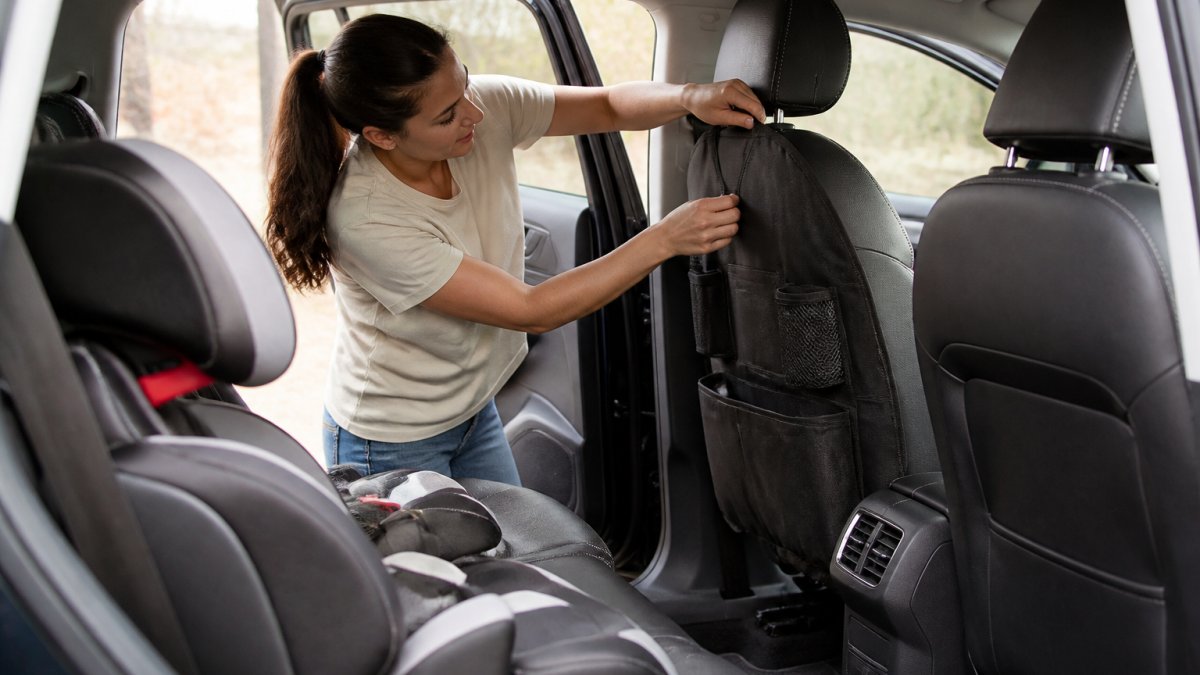
Our car backseat organizer has dedicated pockets and a touch screen tablet holder. It is available in Regular, Side storage and Upgraded configurations.

Our buying guide to the best car backseat organizers for kids walks through what to look for before you spend.
Check Fit Before You Buy
Measure before you order. Check the height and width of your front seat back, the distance to the headrest posts, and whether your seat has a built-in screen or side airbag.
Watch out: organizers that cover the side of the seat can interfere with side airbags. Check your vehicle manual before mounting anything over a seat edge.
Keep Car Seat Safety First
Never strap an organizer between a child car seat and the vehicle seat. Never hang heavy items from a headrest above a rear-facing seat. And never let straps or cords dangle within a child's reach.
The rule is simple: the car seat stays directly against the vehicle seat, with nothing sandwiched between them. Storage goes on the front seat back, the floor, or the trunk, not under or around the car seat.
Backseat Car Organizer Ideas That Match Your Child's Age
A toddler and a ten-year-old need completely different setups, and an infant needs almost no backseat storage at all. Matching the organizer to your child's stage prevents the "it's boring" complaints and the mess that follows. The setups below also account for how many kids share the row, because a single-child configuration and a three-across configuration are not the same problem.
Infants and Rear-Facing Seats
A rear-facing infant seat leaves very little usable backseat real estate, and the priority is protecting the install. Keep storage off the car seat itself and off the seat-back directly in front of a rear-facing child's head.
- Mount organizers on the front passenger seat back only if the child cannot reach or kick them
- Use a small soft-sided caddy on the empty seat beside the infant seat for wipes, burp cloths, and a spare outfit
- Keep a wet bag and a small trash bag in a door pocket, not hanging from a headrest
- Skip cup holders in the infant row, bottles and sippy cups belong in a parent's reach, not the child's
A common pattern is to treat the front passenger seat back as the diaper station and leave the infant row almost bare. That keeps the car seat shell clear and avoids anything dangling near a rear-facing child's face.
Toddlers and Preschoolers
Keep it simple and soft. Toddlers need a few familiar items, not a wall of choices, and they need everything reachable without unbuckling.
- A mesh pocket with two or three board books
- A spill-resistant cup holder within arm's reach, check that it does not sit between the car seat and the vehicle seat
- A small bin for snacks, refilled before each trip
- Wipes and tissues in an outside pocket
Skip anything with small parts, loose cords or hard edges. A toddler's reach is short, so mount the organizer low on the front seat back rather than high near the headrest.
School-Age Kids and Tweens
Older kids want control over their own space. Give them a section and let them manage it.
Car Backseat Organizer (1 piece) →
- A tablet holder for screen time on longer drives
- A pocket for headphones, chargers and a stylus
- A book or activity pouch for screen-free stretches
- A small trash bag they empty themselves
The trick is ownership. When kids manage their own pocket, they stop treating the backseat like a dumping ground. Tweens can also handle a small clipboard or lap desk for homework and drawing, provided it stows flat when not in use.
Multiple Kids in One Row
Three-across seating changes the math. Buckle access matters more than pocket count.
- Assign each child a named pocket or color-coded bin so disputes have an answer
- Keep the center seat's buckle path clear, no organizer should hang into the buckle stalk area
- Put shared items (tissues, trash bag) on the door side, not between children
- Use a single low-profile seat-back organizer rather than three bulky ones that crowd legroom
If two car seats sit side by side, check that the organizer on the front seat back does not block the adult's access to the buckle from the front. A common pattern is to leave the center position empty of storage entirely and use the door pockets for shared supplies.
Road Trip Car Organization for Kids: Packing and Reset System
Long drives break even good systems. The fix is a packing plan and a nightly reset, not more stuff. The system below separates what lives in the car permanently from what goes in for a trip and comes back out, so the backseat does not slowly turn into a storage unit.
The Three-Layer Pack
Pack in layers so you can restock without unpacking everything:
- Daily bag: snacks, wipes, one toy, one book per child, this is the layer kids touch
- Activity bag: crafts, stickers, and screen-free options for stops, this stays closed until needed
- Restock bin: sealed snacks and drinks in the trunk, this is the reserve, not the reachable supply
What Stays in the Car Permanently
Keep a small permanent kit so you are never repacking from zero:
- Wipes and tissues in an outside pocket
- A trash bag in every row
- A spare set of clothes per child, sealed in a bag
- A phone charger and a short cable
Everything else, toys, books, tablets, activity supplies, is trip cargo and should come back inside at the end of the day.
The Nightly Five-Minute Reset
Do this at the end of every driving day, not just road trip days:
- Each child removes their own toys and books and carries them inside
- Empty the trash bag into the household bin
- Refill the snack pocket from the restock bin
- Wipe the cup holder and any sticky surface
- Return the permanent kit to its pocket
The Weekly and Monthly Cadence
- Weekly: vacuum the seats and floor mats, check the gap between the seats for lost items, and rotate the toy selection
- Monthly: deep clean seats and mats, wash removable cloth organizers according to the manufacturer's instructions, and audit the permanent kit for expired snacks or outgrown clothes
A Printable-Style Checklist
Keep this list in the glovebox or on your phone:
- Trash bag emptied
- Snack pocket refilled
- Toys returned inside
- Cup holder wiped
That last box matters most. Loose items on the floor become projectiles in a hard stop, so the reset is a safety habit as much as a tidiness one.
How to Keep a Car Clean With Kids Between Deep Cleans
Keeping a family car clean with kids comes down to small habits, not big cleaning days. A few rules do most of the work:
- No food without a container. Snacks go in a cup or bin, not on the seat.
- One in, one out. A new toy in the car means one goes back inside.
- Trash bag in every row. Kids use what's in front of them.
- Weekly five-minute sweep. Everyone grabs their own items.
Use the Space You Already Have
Most cars have more usable storage than owners realize. The gap between the seats, the space under the front seats, and the back of the front seats all go unused.
Our seat gap filler organizer is designed for insertion into seat seams and provides storage for small items such as pens, cards, or earbuds.

Measure the gap first. Some seats sit too close to the console for a filler to fit, and that's worth checking before you order.
Build Your Backseat Setup With Ride and Roam Co
A tidy backseat is not about buying more. It's about a clean start and a system your kids can follow.
Our backseat organizer has pockets and a touch screen tablet holder. The seat gap filler provides storage for small items.
Frequently Asked Questions
Are backseat organizers safe to use with child car seats?
Yes, as long as the organizer does not sit between the child and the car seat or interfere with the seat's harness, buckles, or tether. Attach the organizer to the back of the front seat or the headrest, not to the car seat itself. Keep loose items secured in pockets rather than resting on the seat, since anything unsecured can become a projectile in a sudden stop. Check that the organizer does not block the car seat's adjustment points, and recheck the fit after every installation.
What should I keep in a backseat organizer for kids?
Stock it with what your child reaches for most: a water bottle, a small snack container, wipes, tissues, a tablet in the touch screen holder, and two or three small toys or books. Rotate the toys weekly so they stay interesting. Skip anything heavy, sharp, or messy, and avoid loose crayons or markers that roll under seats. A backseat organizer works best when it holds a small, fixed set of essentials rather than everything your child owns.
How do you keep toys and snacks organized in the car?
Give each category its own pocket and label it if your kids can read. Use a small lidded container for snacks so crumbs stay contained, and a separate pocket for toys so food and playthings do not mix. Limit the car to a few rotating toys rather than the whole toy bin. At the end of each trip, spend two minutes returning items to their pockets. This routine is the core of how to keep a car clean with kids without a full deep clean every week.
How often should I clean out a car backseat?
Do a two-minute reset after every trip and a fuller clean once a week: remove trash, wipe down hard surfaces, and shake out crumbs from the organizer pockets. Every month or two, take the organizer off and vacuum underneath it, since crumbs and small toys collect behind the seat. If you eat in the car often or have a toddler in the back, shorten that cycle. Regular small cleanups beat one big scrub-down every season.
